Read a race's page: odds, names and news
On this page
Each contest on the Elections page has its own page. It collects what Politics has on that one race: the prediction markets on it with their trends, who holds the seat now, the names the markets lead with, and the newest coverage.
#Open a race page
You can reach a race page in several ways:
- Select a state or district in a race table on the Elections page, or Details on a control card.
- Select the link to a member's race in the side column of their page, when their seat is up.
- Select a race's name on your Following page.
Pages exist for control of the Senate and of the House, each Senate seat that is up, each House district that someone holds, the next presidential race, and any race that has a market, including governor races. A race with no seat up and no market, such as a Senate race in a state with no Senate seat on the ballot, has no page.
#What is on the page
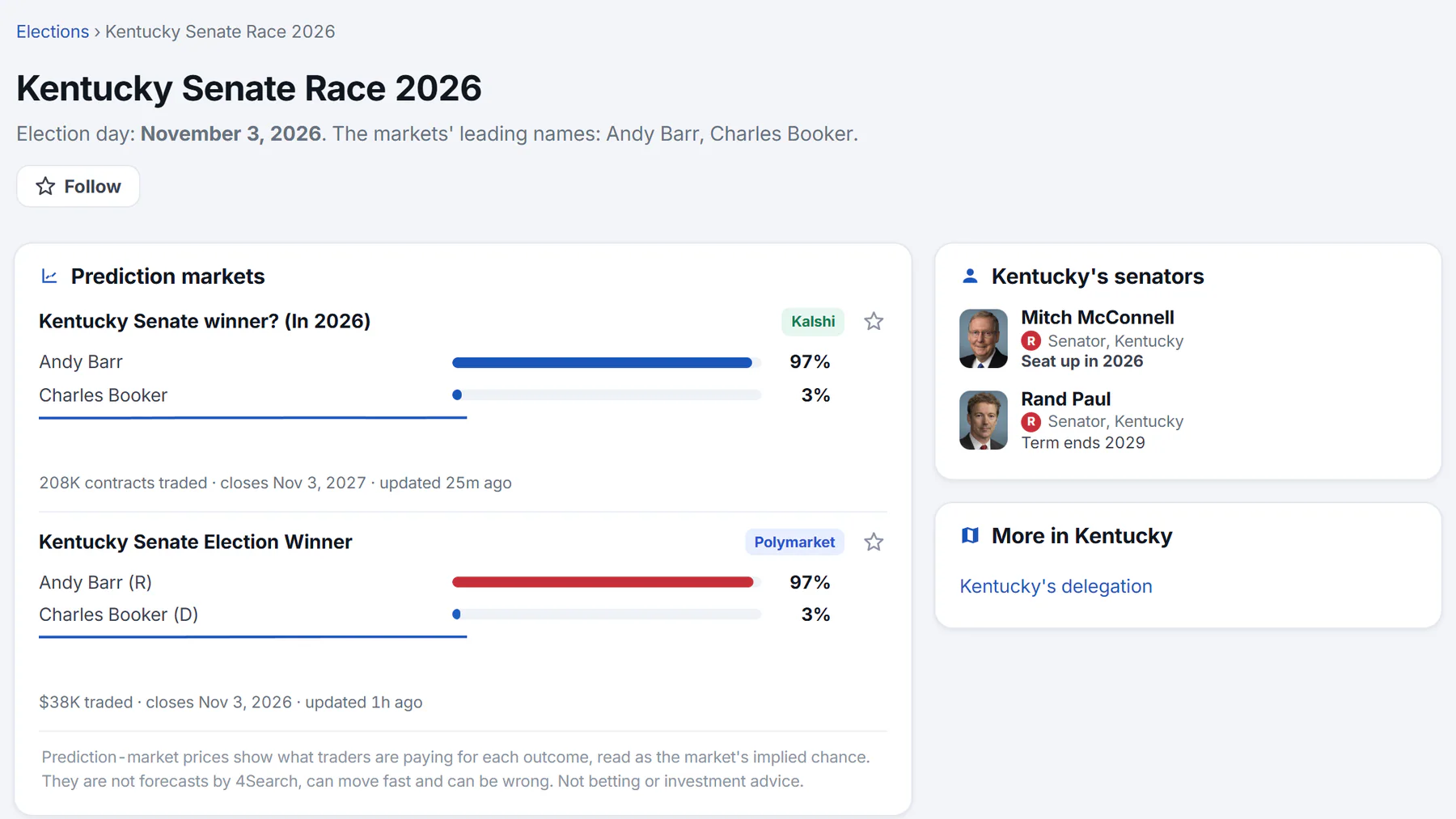
A Senate race page. The markets are on the left; the side column shows who holds the seats and links to the state's other races.
- 1Election day, and the names the markets lead with
- 2Follow the race
- 3A prediction market on the race
- 4Who holds the seat, and which seats are up
- 5Other races and the state's whole delegation
- The title and the date. The line under the title gives election day and, when the markets name candidates, The markets' leading names, up to four.
- Follow. The button under it adds the race to your list.
- Prediction markets. The open markets on the race, each with its outcomes, their chances and the change over a day. A market can ask who wins, the margin of victory, turnout, or how several races will go together. Each card also draws a small line for the leading outcome's chance over the last 30 days, once there are a few days of history. See Prediction markets for how to read a card.
- In the news. Headlines from the last two weeks that name the race or its leading candidates, with a short snippet. When there are none, the card says so.
- Who holds the seat. For a Senate race the card is headed with the state's senators, and the one whose seat is up is marked Seat up in the election year; the other shows when their term ends. For a House race, Holds the seat names the member. A control page shows Seats now by party instead.
- More in the state. Links to the state's other races that have a page, and to the state's whole delegation in the Members list.
An AI Briefing may appear above the markets.
#Common questions
Why does the page say there is no prediction market?
No open market on that race is on record yet. The page still shows who holds the seat and any coverage of the race. A new market appears when one opens.
Why are there several markets on one race?
Exchanges offer more than one question on the same contest: who wins, by how much, how many people vote, or how a pair of races will turn out. Each is a separate market with its own numbers.
Why do two markets on the same race show different chances?
They can ask slightly different questions, trade on different exchanges and be updated at different moments. Each card shows its source and when it was last updated.
What does "Seat up in 2026" mean?
It means the senator's current term ends in January after the 2026 election, so the seat is on the ballot this November. The other senator from the state shows the year their term ends.